Friday, January 7, 2022

Grape Spotlight: Croatian Korčula Grk

Grk is an autochthonous Croatian grape variety that grows exclusively on the south Dalmatian island of Korčula. More specifically it is planted in the sandy and very dry soils around the village of Lumbarda at the easternmost tip of the island. Here, the strip of land between two coastlines is very narrow thus the grapes receive plenty of exposure from sunlight and reflection from the sea.

Grk is also an ancient grape, perhaps older than the vines planted by the Greeks who settled in Lumbarda in the third century BC. They named the island Korkyra Melaina (Black Korkyra) for its dense Mediterranean vegetation.  Interestingly Grk translates to Greek in Croatian but DNA analysis does not match any known Greek grape. In the local dialect, Grk refers to "bitter" which resembles the naming of Negroamaro across the Adriatic in Puglia. Since inhabitants of Korčula were seafarers and travelers (Marco Polo (1254-1324) was purportedly born on Korčula) perhaps the concepts in the naming grapes traveled across the Sea. This happened with actual grapevines for Primitivo as the Croatian Tribidrag was transferred to Italy between 200-300 years ago.

The quest to determine the origins of Zinfandel to Primitivo and to eventually Tribidrag & Crljenak Kastelanski also includes Grk. Dr. Carole Meredith analyzed various DNA fingerprints of vines in search of a match for Zinfandel and this led to Plavac Mali being designated an offspring. In addition, her analysis showed that Grk (along with other local varieties Plavina and Vranac) shared genetic markers with Zinfandel. This helps prove the antiquated nature of these grapes. 

Like two other central European grapes, the Hungarian Kéknyelű and Herzegovinian Blatina, Grk has only the female functional parts of the plant. Thus it is not self-pollinating like the vast majority of grapevines and requires a male pollinator. On Lumbarda, its relative Plavac Mali is the primary pollinator, planted in alternative rows as both varieties blossom at the same time and with hopes that the wind will carry the pollen to the appropriate plants. 

Winemaking on Korčula probably started with the Greek settlers and continued with the Romans but its practices were codified in the Statute of Korčula of 1214.  This is the oldest legal code of the Croats and a subsequent version from 1265 has been preserved to the present day.  It codifies both winemaking practices as well as the trading of wine - specifically the prohibition of imports in large quantities. In contemporary times, winemaking has been modernized particularly from young oenologists such as 30-something Igor Radovanović.

After graduating from high school, Radovanović enrolled at the Faculty of Agriculture in Zagreb, and afterward consulted with several wineries in Smokvica and Čara. This led to working with Testament Winery near Šibenik and Black Island Winery on Korčula and specifically Posip and Grk. On Korčula he created his own small garage winery where he produces several craft wines which are noticeable by their "kružić križić" (circle cross) label. 

One of these wines is the Radovanović Grk 2020 ($39) available in the United States through Croatian Premium Wine Imports and not to be confused with the Serbian winery Radovanovic.  This wine is exceptional and showcases the heavy density and body of Grk wines. It features candied summer fruit, melons, a hint of that Black Korkyra, and surprisingly sufficient acidity. Yes, it stretches the budget but with the small-scale production - well worth the outlay.

Monday, January 3, 2022

Grape Spotlight: Herzegovina Tamjanika (Muscat Blanc à Petits Grains) from Wines of Illyria

Muscat Blanc à Petits Grains is an ancient white wine grape that originated in Greece and spread through southern Europe. In Italy, it is known as Muscat Blanc and the source of sparkling Asti and the semi-sparkling Moscato d’Asti. In France, it is one of that country's most widely planted white grape varieties -- particularly in southern France. And in the Balkins - specifically Serbia and Bosnia-Herzegovina -- local clones of Muscat Blanc à Petits Grains are called Tamjanika

Muscat Blanc à Petits Grains is named for its small berries and seeds (petits grains) and requires a long growing season as its buds early and ripens relatively late. Because of the small and dense berries, it is susceptible to mildew diseases and requires regular canopy management.  Like other muscat grapes, it produces a very aromatic wine either spicy, floral, and\or fruity.  It's high sugar density and acidity encourage vinification into sparkling and off-dry styles. That being said, in the Balkins, Tamjanika wines are generally drier since the hot Mediterranean climate inhibits the accumulation of sugar and acidity. 

In Bosnia-Herzegovina, Tamjanika is grown in the Mediterranean climate of Herzegovina near Mostar where agriculture is influenced by the Adriatic Sea (about 20 miles distance), several rivers, and the Herzegovinian mountains. The vines are generally planted in sandy loam soils at 150 to 1,000 feet above sea level. 

For this Wines of Illyria Galerija Vukoje Tamjanika 2019 ($21.99), the grapes are sourced from Vukoje Cellars -- located near the town of Trebinje on the banks of the Trebišnjica river. Trebinje is the southernmost city in Herzegovina and only 20 miles or so from Dubrovnik. Vukoje Cellars farms two estates with the Zasad Polje vineyards being the source of the Tamjanika. These vines are planted along the Trebišnjica riverbed with the dry and rugged country nearby. This wine starts with a floral aroma then transitioning to lime, grapefruit, and melon with some depth and finishes with food-friendly acidity. 


Tuesday, December 21, 2021

Maryland Bourbon at Twin Valley Distillers

Rockville's East Gude Drive has turned into a mini craft beverage destination with Saints Row Brewing and True Respite Brewing Company bookends to the lone distillery Twin Valley Distillers. I visited this distillery on an early Saturday morning to see the new location they moved into a couple years back. They utilize two sections of the warehouse with the tasting room -- cocktail bar on the right and the distillery itself intersecting on the left.  

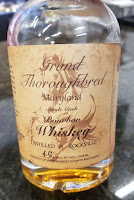
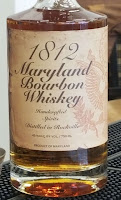
Twin Valley specializes in Bourbon as well as spirits aging in bourbon barrels -- each as much as possible using locally sourced ingredients. Their showcase bourbons are the Maryland Whiskey Company labels -- the Special Year Straight and Single Cask 2-year Straight. For sipping at the bar I chose the Grand Thoroughbred Single Cask Wheat Bourbon which was named after the state horse of Maryland. This is a friendly bourbon, very smooth and round with hay and soft vanilla. Unfortunately, this tasting bottle was the sole survivor until bottling next month. However, the bartender recommended the 1812 Blended Bourbon  ($40, 45%) which combines both of their single cask bourbons. This whiskey has a rounded mouthfeel, caramel, oak, and honey with a slightly smoky tail. A nice addition to my bar. 

Rounding out the portfolio at Twin Valley are the bourbon barrel-aged spirits, clear spirits, and ready-to-drink cocktails & flavored spirits. On the barrel-aged side are the 1794 Bourbon Barrel Maryland Rye Whiskey, Bourbon Barrel-Aged Rum, and the Reverend Paul's Bourbon Barrel-Aged Malt Whiskey. The clear spirits consist of the Norbeck Vodka made from corn and the Maryland Rum Company Silver Rum distilled from molasses from Baltimore's Domino sugar. Finally, there are several flavored spirits and cocktails from Limoncello to Peanut Butter Whiskey. Check out the product list for more details. 

And as always, theCompass Craft Beverage Finder will guide you to this and other craft beverage destinations. Cheers. 

Saturday, December 18, 2021

Swig & Ramble Season 1 Finale: The Tastes of 2021

Thanks to the fine folks at Swig & Ramble for having me as a guest to discuss my favorite spirits of 2021.  In between Mark interrupting Julia we discussed several Virginia and New York craft spirits from Dida's Distillery, Catoctin Creek Distilling Company, Cooperstown Distillery,  Hillrock Estate Distillery, and Kings County Distillery. There's also a shoutout to Florida's St. Augustine Distillery, plus my 2021 favorite -- the Maggie's Farm Rum - Allegheny Distilling Sherry Finished Rum -- American grown sugar cane fermented and distilled in Pittsburgh PA. Follow the Swig & Ramble Facebook Group to receive updates on the 2022 show schedule. Cheers.