Friday, November 16, 2018

The Chalk Hill 2016 Sonoma Red Wine


The Chalk Hill Winery 2016 Sonoma County Red ($24.99) is a friendly wine as our group quickly and easily disposed its contents not long after uncorking. Expect a rich and smooth dark fruit sensation mingling with spices and vanilla, before finishing with a velvety and lingering tail. It is a Bordeaux-ish blend of 86% Cabernet Sauvignon, 9% Malbec, 3% Zinfandel, and 2% Merlot. Whereas the Chalk Hill brand is normally characterized by estate fruit, this wine is derived from grapes sourced from a combination of Chalk Hill estate and Foley Family vineyards dispersed throughout Sonoma County. [Foley Family is the parent company to Chalk Hill Winery.]   According to the tasting notes, the Chalk Hill AVA fruit provides richness, concentration, and nuttiness, whereas the Sonoma County fruit provides fruit forward nuances. These grapes are barrel fermented in French and American oak (20% new) then aged in additional 12 months in barrel. The result is a delicious wine.

Wednesday, November 14, 2018

Finally, a Trip to Dogfish Head Craft Brewery

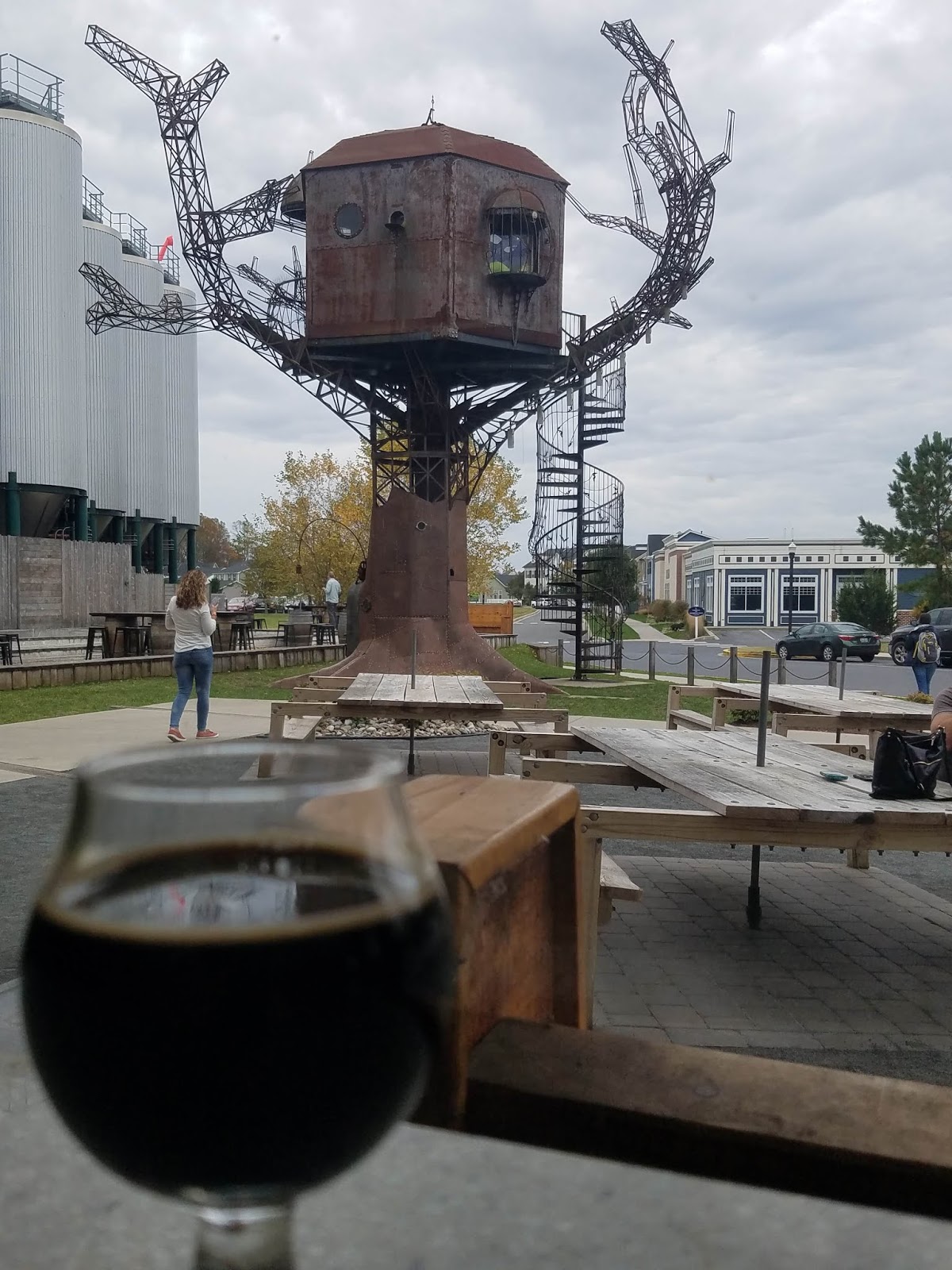
This month I finally was able to visit the holy grail of east coast brewing, Dogfish Head Craft Brewery.  In my opinion, this brewery isn't lionized because of its iconic brands such as the 90 Minute series but because co-founder Sam Calagione freed us from the Reinheitsgebot. Before Dogfish Head opened in 1995, almost all American beers adhered to the key features of this German law -- brewing with just malted barley, yeast, hops, and water. Calagione blew this stagnation out of the water by not only creating non-conformist beers but also becoming a mini-archeologist and brewing craft beverages enjoyed by ancient cultures. Think of excellent and provoking beers such as Midus Touch, Chateau Jiahu, or Theobroma. Then there is his innovation combining wine must and beer as with Noble Rot and Siracusa Nera. Or think of the special oak treatments such as the Palo Santo Marron. Thus, for those who love any of the funky, sour, or just crazy beers brewed by the thousands of craft breweries today, Dogfish Head was the pioneer.

The brewery is located in Milton Delaware, far from Sam's New England heritage and Dogfish Head, Maine in which the brewery is named. Instead, Delaware is the home state of co-founder and current VP Mariah Calagione -- Sam's wife. The brewery first opened in Rehoboth Beach, Delaware as a brewpub which is still operating today as Dogfish Head Brewings & Eats. After those early days the brewery's growth mandated a relocation to a larger facility in Milton, which has continued to expand as demand dictates.

Visitors to Dogfish Head first notice how the facility is massive, with fermenting tanks erected through ceilings and the long, long warehouse. Most are probably unaware of the equally large packaging facility located a football field behind the brewery.  Dogfish Head is easily the largest brewery I've ever seen outside a stop in Golden, Colorado. In fact, their experimental R&D unit alone is larger than most craft breweries. According to the Brewers Association, in 2017 Dogfish Head produced 276,243 barrels of beer. In comparison neighboring Crooked Hammock Brewing released 1,300 barrels and Burley Oak Brewing Company in Berlin, Maryland 2,800 barrels.  Yet Dogfish Head is still only the 12th largest independent craft brewery as defined by the Brewers Association.

In contrast to the brewing size, the tasting room is rather small - more comparable to a routine craft brewery. Obviously then, off season is the most opportune time to visit as I heard horror stories of long summer queues.  And there is no shortage of beers available as they pour close to two dozen beers as samples, pints, crowlers, or growlers. Where else can you find the 120 Minute IPA, Bourbon Barrel-Aged Palo Santo Marron, Pennsylvania Tuxedo, Viniferous IPA, or Wood-Aged Bitches Brew all in one spot. They even pour beers that have graduated from their R&D system but are not intended for wider distribution.


The tasting room is also where visitors schedule tours - and Dogfish Head offers several varieties. The shortest is the Quick Sip a 25 minute free tour that includes four free samples of beer. The hour long Off-Centered tour is most recommended where for $10 participants receive four samples and stops at " our 200-barrel brewhouse, Off-Centered Center and even our new R&D system where you’ll have a chance to sample one of our experimental brews and we finish the tour out at our packaging facility where we show you have everything is kegged, canned and bottled".  Of notable interest is the original brewing equipment (a bucket and electronic football game) used by Calagione to develop the 90 Minutes series. And on our tour we sampled an excellent IPA that most likely won't even make it into the tasting room. And for visitors who really plan ahead look for the limited Grain To Glass, Randall Jr., and Distillery tours with access to normally off-limit parts of the brewery. And yes the distillery official relocated from the Rehoboth Beach brewpub to a larger pasture in Milton.

For those heading to the Maryland or Delaware beaches, visiting Dogfish Head takes just a slight adjustment from your route.  For those brewery tourists, visit nearby Lewes and Rehoboth Beach to broaden your craft beverage trip. And as always, theCompass Craft Beverage Finder will guide you there.

Monday, November 12, 2018

Santa Cristina and the Italian IGT

Most of Italy's wines are labeled DOCG (Denominazione di Origine Controllata e Garantita) or DOC (Denominazione di Origine Controllata), classifications that set rules governing concerning the viticultural zone, permitted grape varieties, wine styles, and more. Barolo DOCG, Chianti Classico DOCG, Prosecco DOC, and Soave DOC are popular examples of each.

However, many wines failed to qualify for DOC or DOCG status, not because they were of poor quality, but because they were made from grape varieties (or blends) not sanctioned under DOC/G laws. One example are the Super-Tuscans -- Sangiovese blended with international grape varieties. Thus in 1992 the IGT (Indicazione Geografica Tipica) was created -- granting winemakers more freedom to create unique blends. IGT wines are only required to state the vintage, region of origin, and producer name on the label and be made from at least 85% grapes from the region.

Santa Cristina is one establishment that utilizes this classification by creating several Toscana IGT wines. The winery is located in the small historic town of Cortona and in 1946 Niccolò Antinori released their first vintage -- a Chianti Classico. However, with the passage of the 1984 DOCG laws requiring lower vineyard yields, Chianti Classico grapes became so complex and rich that they required more aging than what this fruity, fresh wine should have. In 1987, the winery stopped using the Chianti Classico designation and in 1994 adopted the IGT classification by adding Merlot to soften their signature red wine. This wine has evolved into the Santa Cristina Rosso Toscana IGT and I recently received a sample accompanied by two other Santa Cristina wines. In general, they provide immense quality at a noticeably reasonable price point. Cheers.

Santa Cristina Rosso, Toscana IGT 2016 ($13)
The Rosso not only incorporates Sangiovese and Merlot, but also Cabernet Sauvignon and Syrah. Each of these grape varieties were fermented separately  , then blended and aged partly in oak and stainless steel. The result is a dry, but fruity wine - very food friendly -  with juicy and savory texture finishing with moderate and lasting tannins. Give me a burger or pizza.

Santa Cristina Cipresseto Rosato, Toscana IGT 2017 ($14)
Santa Cristina was one of the first Italian wineries to release a rosé wine and is named after the cypress trees which reside in the Tuscan landscape. This wine is predominately Sangiovese and offers soft red apples and strawberries followed by a long and fresh finish. Nicely done.

Santa Cristina Pinot Grigio, delle Venezie DOC 2017 ($13)
In the past this would have been referred to as an IGT delle Venezie wine but in 2017 the delle Venezie DOC was created that covers the Friuli-Venezia Giulia, Trentino-Alto Adige, and Veneto regions. Seven out of ten delle Venezie wines are Pinot Grigio and this grape variety is required to be 85% of the bottled wine. This is another soft wine, with citrus and green apples dominating the palate with a velvety texture and lasting tail. A great example of delle Venezie Pinot Grigio.

Friday, November 9, 2018

Dave Pickerell and George Washington Rye Whiskey

Last weekend I had my first opportunity to taste the Limited Edition George Washington Rye Whiskey ($185) distilled directly onsite at Mount Vernon at George Washington's Distillery® and Gristmill. The distillery is a fully functional reconstruction of our First President's distillery which in 1799 was one of the largest whiskey distilleries in America. At that time six distiller slaves operated five copper pot stills continuously throughout the year. In 1799, Washington’s Distillery produced almost 11,000 gallons of whiskey, valued at $7,500 (approximately $120,000 today) while the average Virginia distillery produced about 650 gallons of whiskey per year which was valued at about $460.

The whiskey I sampled is based on a recipe used by Washington and his farm manager, James Anderson, and was crafted by Master Distiller David Pickerell using original methods available at that time. The spirit was double distilled using a mash of 60% rye, 35% corn and 5% malted barley. For an un-aged spirit it possesses plenty of weight with slight spice and sweetness that burns off slowly. Sadly and unbeknownst to me, Pickerell had passed away a few days earlier at the age of 70. Terrible news and the Whiskey Wash's obituary described how influential Pickerell was to the spirits industry and particularly to American rye whiskey. God bless.