Saturday, March 6, 2021

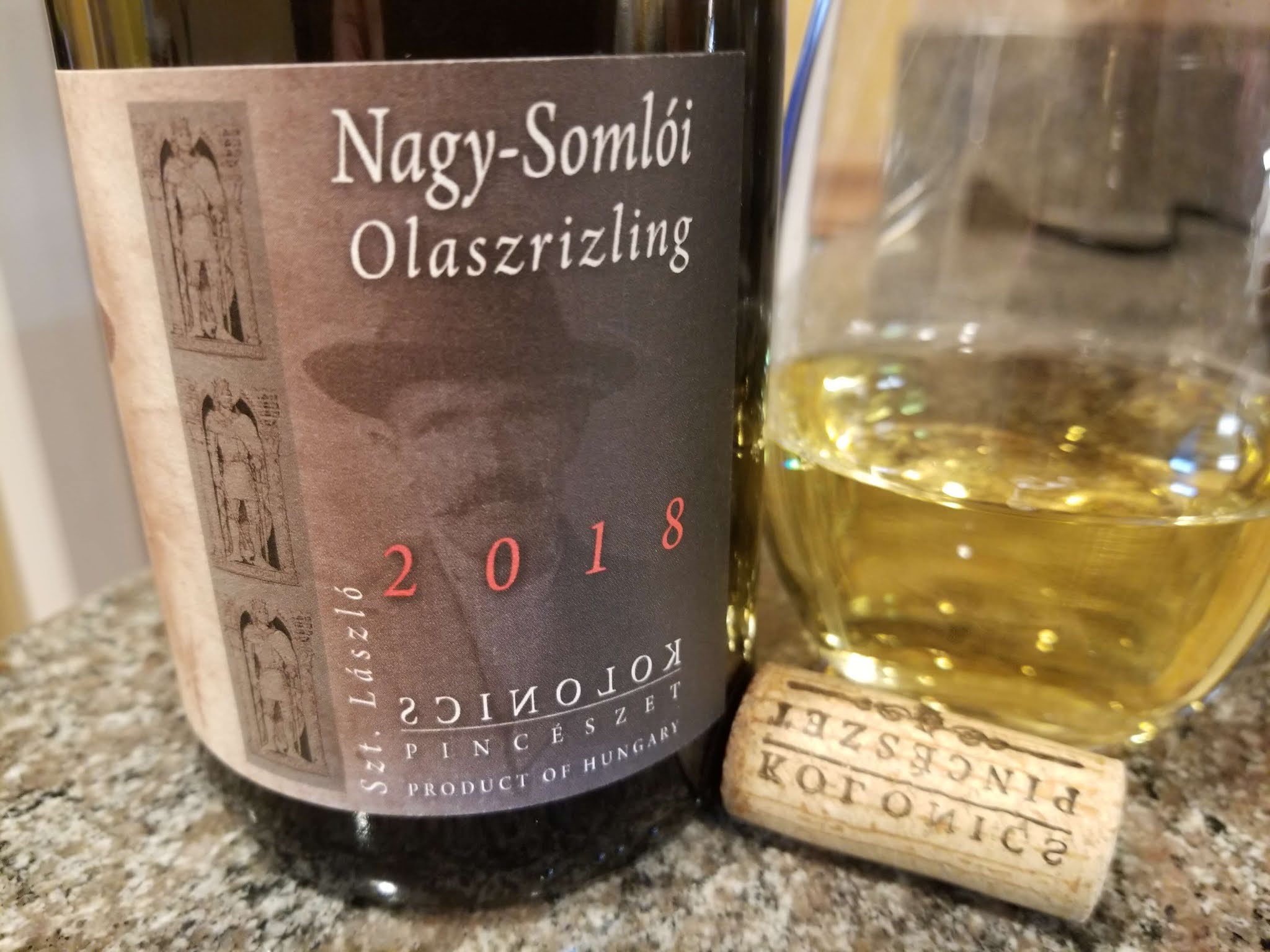
Grape Spotlight: Nagy-Somloi Olaszrizling

The most widely planted grape variety in Hungary is Olaszrizling, also known as Welschriesling to a wider European audience.  In many cases, Olaszrizling wines are rather pedestrian, light, and neutral, where they are favored in boxes, jugs, or as the base for the Hungarian wine spritzer: fröccs.  However, in a particular microclimate with volcanic soils or in specific environments these wines find a more complex expression such as in Magyarország's second smallest wine region -  Somló. This region is only 507 hectares and is basically a single hill that was an active volcano millions of years ago when the Pannonian Sea covered what is now central Europe. 

Today the hill is populated by multi-generational small family farms that were not confiscated during communism. Collectivized and socialist agriculture never gained a foothold in Somló thanks to its small size and the hill's steep slopes. These were inaccessible to machines and large-scale agricultural methods. Many of these small farms are vineyards planted in the rich volcanic black basalt soil that helps winemakers create minerally driven wines. The soil also helps warm the grapes during chillier days by absorbing heat and then radiating it back towards the vines.  

Kolonics Pinceszet is one of these multi-generation family farms and cultivates Olaszrizling on two hectares on the south-east side of the Somló hill -- specifically in the Apátság vineyard.  Károly Kolonics produces several versions of Olaszrizling wine, and each starts with six to 12 hours of skin contact before pressing and fermented using only indigenous yeast. The differences in the styles result from oak aging in various large and old barrels (1,000 or 1,500 liters). In the instance of the Kolonics Pinceszet Nagy-Somloi "St. László" Olaszrizling 2018 ($25), the wine was aged exclusively in the "St. László" barrel -- a 1,500-liter, steam-bent oak cask -- for one year. The wine is rich in tropical fruit and laden with minerals providing a smooth flow to the finish.  We couldn't stop ourselves from finishing the wine in one sitting. Egészségére. 

Monday, March 1, 2021

Mezcal El Silencio Espadín and the Taco Bamba Grapefruit - Vanilla Margarita

Continuing our venture into Mezcal, we recently purchased the Mezcal El Silencio Espadín ($30), a very traditional product produced in San Baltazar Guelavila, Oaxaca, and from 100% organically grown Espadin agave. According to the bio, the spirit is made by Pedro Hernández, a ninth-generation Maestro Mezcalero, and double-distilled in small batches. Apparently, in 2019 Constellation Brands took a minority stake in El Silencio which most likely explains how it's available in the local ABC store 

When sipping neat, it starts with the smokey agave aroma that we've come to expect, and then the palate is smooth and textured - with a soft profile.  I then added lime juice which added a little kick and interestingly boosted the aromatics. But we found its most usefulness, was the filler for the Grapefruit - Vanilla Margarita mix from Taco Bamba.  The smokiness added to the cocktail and the vanilla gave the feeling of aged mezcal -- but just to a Reposado. Cheers.

Thursday, February 25, 2021

Earning Night-time Driving Hours to Backroom Brewery

One night this week my soon-to-be-driving son asked if we could drive for a couple hours so that he could earn night-time driving hours. Of course, I replied, as long as it includes a stop at Backroom Brewery - over an hour away as shown by theCompass Craft Beverage Finder.  I had been targetting the brewery after several trips to visit the Sip Shenandoah Trail and learning that the brewery was Virginia's first farm brewery.  The operation is an outgrowth of the Sunflower Cottage herb farm where they planted hops in 2012; helped Warren County pass an ordinance to allow farm breweries in 2013;  built out a brewery that following year; and finally, opened an expanded brewery, event center, and tasting room in 2019. 

With that expanded capability BackRoom offers almost two dozen beers in their tasting room, many brewed with homegrown herbs. The perfect example is their flagship Lemon Basil Wheat Ale,  brewed with fresh lemon zest & sweet basil -- and a remembrance of the days twisting lemon juice into Pyramid Hefeweisen.  The Kiss Me Kolsch and Regions Pilsner are solid thirst quenchers and the Backpacker Pale Ale a reminder of the old school pale ales without the hop punch.  However, the two favorites were the Shenandoah Sunset Hazy IPA and the Farmwork  Rosemary Rye Saison -- both just delicious versions of what you would expect from the styles and the ingredients. 

We hope to visit again soon on a weekday to savor more of these beers and try the kitchen. Cheers. 

Monday, February 22, 2021

Virginia Wine Chat — A Taste of the Shenandoah Valley

In 1982, the Shenandoah Valley AVA became the first  American Viticultural Area established in Virginia - and for that matter in West Virginia too as the boundaries include both Berkeley and Jefferson Counties in the Eastern Panhandle.  The fruitful valley is bounded by the Blue Ridge Mountains to the east and the Appalachian and Allegheny Mountains to the west.  It is one of the largest AVAs in the country ranging about 150 miles northwest-southeast and 25 miles wide. This leads to several micro-climates allowing for a diverse planting of grapes, but in general, this cool climate region shares a predominate limestone soil and large diurnal temperatures - leading to more acidic grapes. (TTB - AVAs)

On Sunday, February 20th, Frank Morgan (drinkwhatyoulike.com) presented his Virginia Wine Chat on A Taste of the Shenandoah Valley featuring three wines from prominent wineries in that AVA.  This tasting was organized as an afterthought of the 2020 Shenandoah Cup wine competition, which Morgan oversaw, and where Cave Ridge Vineyard was awarded the cup for their 2017 Shenandoah Valley Petit Verdot.  This wine was aged 100% Hungarian Oak and during the chat Cave Ridge owner Randy Phillips discussed his decision to use this treatment -- particularly lower costs without substituting quality.  

As a recap on Hungarian oak, the barrels are made using Quercus petraea, sessile oak, from the Zemplén Hills in western Hungarian. This forest is close to Tokaj and contains the same rocky and volcanic soil that gives the Furmint grape its minerality. Sessile oaks make up over 95% of the acreage because that tree prefers tough conditions where the soils are stony and dry, and where the climate is colder. The tree then grows slower, creating a tight grain which leads to lower tannins and a richer aroma in barrels. This tightness also results in lower evaporation and smaller oxygen penetration.

Here are the descriptors of the wines and readers are highly encouraged to visit the Shenandoah Valley Wine Trail

2018 Brix & Columns Virginia Chardonnay ($26)
Allow to warm in glass; creamy lemons aroma, golden delicious apples dominate its profile with a little lychee, creme brulee. Barrel fermented and nine months in new and neutral French oak provides weight and doesn't diminish the lifting acids. 

2017 Bluestone Vineyard Estate Cabernet Franc ($25.50)
The grapes were grown in the highest elevation block of their estate and only free-run juice was fermented and then 40% aged in new French and 60% Hungarian oak. Bright cherry aroma, layers of dark fruit, finishing with firm and chewy tannins. Best feature - lack of vegetable or green peppers characters. 

2017 Cave Ridge Vineyard Shenandoah Valley Petit Verdot ($35)
The fermented wine was aged 100% in Hungarian oak barrels. Very amaro-ish; herbal olive leaf, chocolate coffee, & cherry aroma, chalky velvety character,  dense fruit,  rising acidity, approachable tannins.