Showing posts with label Rakija. Show all posts

Wednesday, July 1, 2026

Spirits for the World Cup Knockout Round: July 1, 2026

Over the years I’ve built a small global library of distilled spirits and fortified wines, and the World Cup Knockout Round feels like the perfect excuse to dig back into it - researching the producers, revisiting the bottles, and tasting my way through the bracket. Starting with the June 29th matches, I’ll be recommending one or two spirits for each game, whether they’re already on my shelf or simply deserve a place in the lineup. Click here to view the other World Cup Knockout Round matches.  Today's matches for July 1st. 


England vs Congo DR

Sipsmith London Dry Gin (England)
Sipsmith London Dry Gin is built on a straightforward, classical approach to English gin: a traditional copper‑pot distillation and a recipe centered on clean, expressive botanicals. The distillery uses ten botanicals — including juniper, coriander, lemon peel, orange peel, cassia, cinnamon, orris root, angelica, licorice, and almond — all steeped overnight to extract essential oils before distillation. This method emphasizes clarity and balance rather than modern flavor additions, keeping the profile firmly rooted in the London Dry style.
Production follows a one‑shot method, meaning every botanical goes into the still and the resulting distillate is used as‑is, without blending or redistillation. Distillation takes place in small Christian Carl copper pot stills, where slow runs and manual cuts help preserve juniper structure, citrus lift, and the subtle earthy notes contributed by orris and angelica. The process is intentionally simple: no vapor‑infusion, no post‑distillation adjustments, and no added flavors. It’s a traditional workflow designed to maintain consistency and highlight the raw materials.

The finished gin is bottled at 41.6% ABV and presents a classic London Dry profile. Juniper leads with crisp pine and citrus oil, followed by coriander spice, orange brightness, and a light sweetness from licorice and almond. The palate is clean, balanced, and versatile, making it suitable for martinis, gin‑and‑tonics, and other classic cocktails. 

Congo DR
Lotoko, also known by the slang term pétrole, is a home-distilled alcoholic drink or moonshine in the Democratic Republic of the Congo. Lotoko is usually made from maize, but sometimes from cassava or plantain. Heads of corn are cut up and boiled into a mash which is then fermented and distilled using improvised stills made from cut-down oil drums. Although it is officially banned because of its high alcohol content (over 50%), its production is widespread in the Democratic Republic of Congo.


Belgium vs Senegal

Belgium
Like the Dutch, Jenever (also known as genever or genièvre) is the national distilled spirit of Belgium.  It is distilled from a base of malt wine (fermented from malted barley, rye, and sometimes corn), giving it a fuller, maltier profile than standard gin.  And in 2008, Jenever has held a Protected Geographical Indication (PGI) status within the EU, recognizing its origins in the Netherlands and Belgium.

Senegal
Bissap (hibiscus juice) is the national drink of Senegal.  It is a non-alcoholic beverage made from the dried flowers of the Hibiscus sabdariffa plant, known for its floral, tangy, and refreshing taste, often prepared with mint and sugar. 


USA vs Bosnia and Herzegovina

Laird’s Tenth Generation Bottled in Bond Apple Brandy (United States)
It’s almost surreal to think that America’s oldest licensed distillery isn’t a bourbon house or a rye pioneer — it’s Laird & Company, a family‑run New Jersey distillery whose apple spirits have satisfied American palates since the 1700s. The Laird family has distilled through wars, Prohibition, industrialization, and ten generations of stewardship, making their Tenth Generation Apple Brandy a living piece of American history. 

The brandy begins with fresh‑pressed apple cider sourced from orchards across the Mid‑Atlantic, then fermented to preserve crisp fruit character and natural acidity. Distillation takes place in traditional copper pot stills, yielding a spirit that balances orchard brightness with depth from concentrated apple skins and seeds. Maturation unfolds in charred American oak, where vanilla, spice, and gentle tannin integrate with the apple‑driven core. The Tenth Generation Bottled in Bond release highlights the family’s ongoing commitment to heritage production — consider it a bridge between colonial‑era applejack and modern American craft distilling.

Laird’s Tenth Generation opens with baked apple, cinnamon, toasted oak, and subtle caramel on the nose. The palate is warm and expressive: apple pie, clove, vanilla, citrus peel, and a touch of roasted nut, all carried by the natural fruit sweetness of long‑aged apple brandy. The finish is long with lingering spice, oak, and apple‑skin tannin. This bottling stands as a benchmark American apple brandy — a spirit that captures the continuity of ten generations and the enduring soul of American distillation. Happy 250th. 

Gazdina Rakija Vilijamovka - Williams Pear Brandy (Bosnia & Herzegovina)
Rakija is the cultural centerpiece for the countries that emerged from the breakup of Yugoslavia - and that is particularly the case in Bosnia and Herzegovina. In this multiethnic country, where the parliamentary republic has a tripartite presidency, rakija is a unifying force and a symbol of hospitality, craftsmanship, and generational continuity. In this landscape, Gazdina has emerged as one of the region’s modern standard‑bearers, blending traditional distillation with orchard‑driven precision. 

The Vilijamovka begins with fully ripe Williams pears, harvested at peak aromatic intensity from orchards across Bosnia and Herzegovina. Fermentation is slow and temperature‑controlled, preserving delicate esters and the natural pear‑skin aromatics that define great Vilijamovka. Distillation takes place in small copper pot stills, where careful cuts ensure clarity, texture, and unmistakable varietal character. Gazdina’s philosophy is rooted in purity — no added sugar, no artificial flavoring, no shortcuts — just fruit, fermentation, and copper. After distillation, the spirit rests to integrate and soften, allowing the pear’s floral and honeyed notes to fully develop.

Gazdina Vilijamovka opens with fresh pear, white blossom, honey, and subtle citrus on the nose. The palate is clean, expressive, and all Williams pear. The palate concentrates on ripe orchard fruit, subtle spice, soft sweetness, and a touch of roundness. The finish is long and fruit‑forward, with lingering pear, floral lift, and a little minerality. 

Monday, January 16, 2023

Yebiga BELA Rakija -> Award Winning Rustic Plum Brandy

Imagine being the founding member of the rock band Faith No More and in 1992 opening for Guns n' Roses in Budapest, yet the most memorable event at that concert was backstage being introduced to a local fruit brandy -- known as palinka in Hungary and rakija throughout the Balkins. That was the experience of bassist Bill Gould who continued his education of rakija through subsequent Balkin tours as a musician and tourist for the subsequent 25+ years.

"During this time, I have been frustrated by the lack of awareness, as well as lack of availability, of what I believe to be one of the world's Great Spirits. And I wanted it for myself as well...I had people occasionally bring me bottles from the Old Country but sometimes they would break and when they did, a piece of my heart would break as well!  Finally, in 2019 I realized that the only way to bring a premium version of this to the US was to do it myself. I had no experience with this industry but set out with a goal to bring a true, completely traditional handmade version -- the kind that is usually kept within the family and rarely offered for sale--to the US for the first time".

What Gould witnessed is how rakija is an intricate part of Eastern European life used to welcome visitors, toast celebratory occasions, or just a jolt of comfort. Home distillation is quite common and I can personally attest, is superior to some of the highest-quality fruit brandies on the market. Rakija is made from a number of fruits, from grapes, apricots, quince, pears, and with most popular, plums - referred to as slivowitz. 

By launching Yebiga, Gould is introducing the traditional processes of home distillation to a retail market. Currently, there are two plum brandies within the Yebiga brand: BELA, a clear rakija and PRVA, an oak-aged rakija. The spirits are distilled on a mountain farm near Kraljevo in Central Serbia. The plum orchard sits at 800m, the highest elevation point for plums, and subsists alongside pines and other conifers. BELA is produced from an equal share of čačanska rodna and čačanska lepotica plums -- both varieties created by the Institute of Fruit Growing in Čačak, Serbia. This is the equivalent of Cornell AgriTech regarding the development of new grape varieties. Both of these plums were released in 1975 and according to the Institute, are high-quality cultivars most suitable for desserts and slivowitz. 

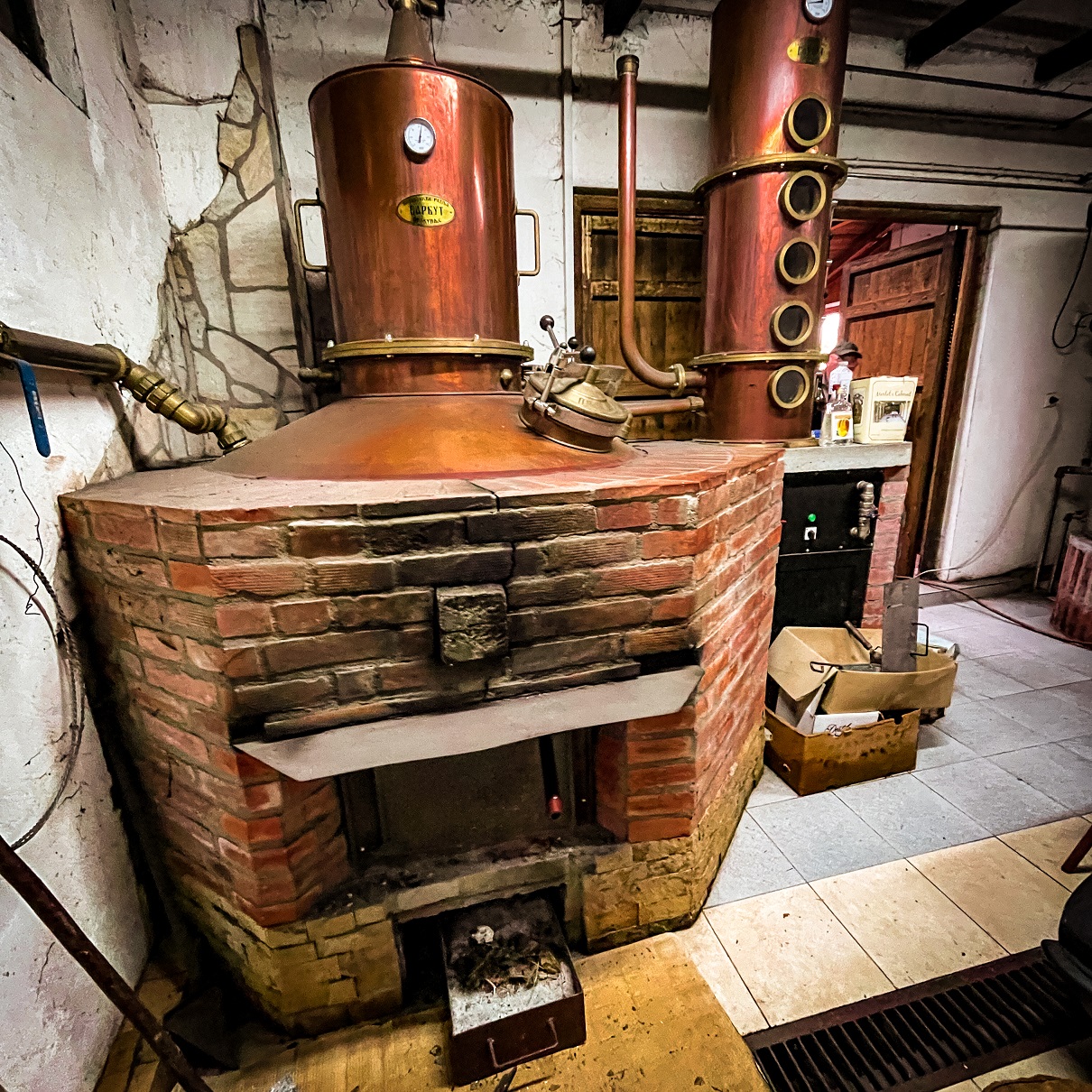
The plums are hand-harvested at full maturation which is quite labor-intensive since individual plums ripen at different intervals. This period lasts from late July to early August and after harvest, the pits are removed, and the fruit ferments from 10 days to 14 weeks. The fermented juice is then double distilled using a 500l wood-fired copper pot still. The wood for the fire is acquired from the local forest. Finally, the rakija is cut to 40% abv using pure mountain spring water. 

Having no oak treatment the BELA provides a full expression of the fruit - from the cultivars to the evergreen terrain. Not sure if my sensory impressions were influenced by their story, but there's subtle pine mixed with the stone fruit aroma. Plums are clearly noticeable on the palate just before the soft burn and lengthy finish. I can see why the BELA was awarded double gold at the  2021 San Francisco World Spirits Competition. 

The Yebiga rakija is currently available online via Mash&Grape ($31) and Yebiga and at retail locations in the following states:  CA, IL, NY, NJ, DC, FL, TX, MO, & MI. There is a map of retail stores on the Yebiga website. Finally, they are available at Total Wine in California and Texas as well as at Binny's in Illinois.  


Orchard and still photos courtesy of Yebiga.

Disclosure: We received samples from Yebiga through the BevFluence New Perspectives on Cider, Perry, and Brandy campaign in order to share our opinion about their products.

Monday, November 15, 2021

Gazdina Vilijamovka Rakija from Republika Srpska, Bosnia

I purchased this bottle of Gazdinav Rakija Vilijamovka ($34) a while ago and just getting around to opening it. The Williams Pear is forefront with a creamy interior and an ethanol creeping burn. Serving chilled kills the burn with only a little effect on the aroma and flavor.

The producer, Prijedorčanka AD, is the largest fruit processor in Bosnia and Herzegovina, as well as the largest producer of fruit distillate in Europe. Interestingly, they are located in the Republika Srpska -- one of the two entities of Bosnia and Herzegovina, the other being the Federation of Bosnia and Herzegovina.

The fruit is grown in the Potkozarje region -- also known for its apple and plum orchards.  The fermented fruit is then distilled using column stills and the warehouse can store over 1,700,000 liters. That's a large facility. 

Monday, October 19, 2020

Serbian Rakija: Zaric Šljivovica & Hubert 1924 Quince

Rakija is an eau de vie styled fruit brandy popular in Slavic and Balkan countries and in Hungary where it is known as Palinka. It is the national drink of Serbia and the plum variety (Šljivovica) is actually a registered trademark with a Protected Designation of Origin (PDO). Rakija is also distilled from other fruits such as apricots, grapes, pears, and cherries where the fermented fruits are "baked" and not boiled in the distillation process. The first distillation is referred to as "soft brandy" whereas the second distillation is called prepecenica -- or "double-baked".  Plums are double-baked whereas apricot, quince, and pear brandies are often soft brandies in order to retain the fruit fragrance.

Historians claim that the spirit arose in the Balkans in the 16th century as a result of the Turkish invasions of the 14th & 15th centuries. However, there is now three separate archaeological evidence that Rakija was being distilled in Bulgaria in the 11th century.  Regardless of origin, rakija has been and still is a family staple throughout Eastern Europe. 

With Šljivovica, producers use different plum varieties and blend these together -- either combining before fermentation or after distillation. Three of the most popular plum varieties are Požegaca, Crvena Ranka, and Trnovaca. The latter is an older cultivated species of plum which are small and round and provides rich fruit. Crvena Ranka is another ancient species that is larger and thrives in poorer and drier soils. It is also sterile and thus needs to be pollinated by another plum species - often  Požegaca or better known as Damson.  However, this plum is very sensitive to frost and the Plum plox virus (a viral disease), thus vigilant care is taken in the orchards. 

Besides varietal differences within a rakija spirit, there are also geographic differences. For instance, in the Kosjeric region of western Serbia, fruit ripens late in the growing season due to the area's higher altitude. This translates to a ratio of sugars and acids and higher quality fruit sought by distillers.  In the Vojvodina province on the Carpathian Basin -- the plain that remained when the Pliocene Pannonian Sea dried out -- is full of rich and fertile loamy loess soils.  As a result, agriculture dominates in Vojvodina as the soil ensures a good supply of plant-available water, soil aeration, and various minerals. I recently purchased two Serbian Rakija from each of these areas. 

The Zaric Distillery operates in Kosjeric and produces numerous rakija from local fruit including the Zaric Distillery Kraljica ($52). Kraljica translates to Queen, is PDO protected, and is a prepecenica Šljivovica produced by the three plum varieties discussed above: Požegaca, Crvena Ranka, and Trnovaca. After the second distillation, the spirit is aged for a minimum of seven years in oak,  converting the clear Rakija into a style similar to cognac.  Even with the oak aging, plums leap through the nose and remain on the palate with a layer of smoke that lasts in a low burn setting (42% abv). I really like the smokiness as it doesn't overpower the fruit. 

Destillerija Hubert 1924 is located in Vojvodina - specifically in Banatsko Veliko Selo - near the Romanian Border. The family distillery was founded in 2007 but the building that houses the distilling operations was built in 1924, hence the name. They produce six brandies (Quince, Apricot, Apple, Plum, Pear, Cherry) using an old family recipe and the traditional double distillation in copper cauldrons. The fruit is sourced from the 15 hectares family orchard estate. Since quince is not fairly known in the U.S., I grabbed a bottle of the Dunja Quince Brandy ($44). Quince (Dunja in Serbian) is a pome fruit, related to apples and pears, that when ripe is bright yellow and looks like a fuzzy, short-necked pear. As a raw fruit, it is too sour and astringent to eat so is most often used in jams, cakes, and rakija.  It also has a relatively low sugar content in that 70 kg of fruit is necessary to produce 1 liter of brandy and fermentation occurs from autumn to spring. The flavor profile of this rakija is quite interesting with strong tropical aromas like pineapple but a more subdued pear inspired core. And very smooth at 40% abv.

Wednesday, October 24, 2018

Eastern European Moonshine: Rakija, Palinka, Slivovitz

Some of the greatest moments when traveling to Eastern Europe is when you are handed a vessel that doesn't contain its original liquid. Instead it is filled with homemade palinka or slivovitz, a fruit brandy distilled clear and usually at exceedingly high abv - sometimes reaching 70 proof. The liquid has heat, but in the best cases portrays the fruit nicely with a burn that evaporates rather quickly. The brandy is derived from a range of harvested fruit such as peaches, plums, Meggy (sour cherries), Quince, Grapes, Pears, or Apples and has different versions throughout central and eastern Europe: Albania, Austria, Bosnia, Bulgaria, Croatia, Czech Republic, Greece, Hungary, Montenegro, Poland, Romania, Serbia, the Slovak Republic, and Slovenia.

In most of these countries the spirit is called Rakija or the domestic equivalent to that word and is usually the most popular spirit in that country. In Serbia it is known as Slivovitz, made from plums, and is that country's national drink. In Hungary and parts of Austria it is known as Palinka and the first records of its consumption date from 1332. Landowners, Cistercian monks and Jewish residents continued the traditional methods of double distilled after the fruit has naturally fermented. Today Palinka is widely produced and consumed both legally and illegally and the government is currently battling the EU to legalize the distillation of small quantities of palinka for home use. Home distillation is so popular in Hungary that department stores sell small distilling kits.

In Croatia where Rakija is the most popular spirit, it is sometimes infused with herbs to create Travarica which is usually served at the beginning of meals. Croats in central Croatia enjoy šljivovica, a version of plum brandy, and in throughout the Adriatic different islands and regions infuse with bitters, anise, walnuts, and honey.

In the Washington DC area, access to this spirit is limited. In Virginia most ABC stores carry the kosher Maraska Slivovitz Old Plum Brandy made in the historic city of Zadar. The ABC store in the Arlington section of Courthouse carries a range of Slivovitz from Serbia and Bosnia and in Clarendon or DC check at the Ambar Restaurant which carries a range of Serbian Slivovitz. The Quince is my favorite. In DC, MacArthur Beverages and Schneider's of Capitol Hill carry the Czech Jelinek Slivovitz and many others stores carry a version of Serbian Slivovitz. And in Maryland, the Montgomery County stores carry both the aforementioned Jelinek and Maraska labels as well as the Hungarian Zwack Slivovitz. Cheers.