Wednesday, February 9, 2022

Richmond Cider Roundup During CiderCon 2022

CiderCon 2022 provided Richmond cideries a tremendous platform to showcase their ciders during several after-hour events. Augmenting the River City's vibrant craft beer scene are three cideries, Buskey Cider and Blue Bee Cider (located in the popular Scotts Addition neighborhood) and Bryant's Small Batch Cider -- situated just south of the State Capitol.  A few weeks ago I was able to visit Bryant's primary orchard tasting room in Nelson County and gained an appreciation of that operation. However, the first night of the conference was my first visit to both Scotts Addition cideries. 

Buskey Cider

Buskey seemed to be the center of attention at CiderCon hosting tasting events on consecutive nights. They started by pouring cider from almost a dozen other Virginia cideries including Albemarle CiderWorks and Old Town Cider.  This Winchester cidery's dry Albemarle Pippin cider is excellent and its sharp dry finish was very similar to Buskey's dry cider.  Both are very worthy everyday refreshing ciders.  CiderCon also allowed me to meet a few orchard growers who tutored me on the intricacies of the Black Twig apple which led to a more interesting tasting.
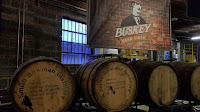
On the second night, I participated in a seminar presenting Buskey's barrel program.  This session consisted of a sampling of five barrel-finished ciders, all but one currently bottled. These ciders all started from Nelson County apples which were fermented dry then placed in different barrels they purchased through a broker. One of these was a Gin barrel and this imparts several botanicals into the cider's aroma leaving citrus and some coconut on the finish. The Brandy barrel overwhelmed the cider with too much apple fruit and was the least favorite. The Mezcal barrel imparted an abundant amount of smokiness, but in an enjoyable amount, which elevated this as one of my favorites. The Sherry was also appreciated because of the nuts and dried fig and raisin flavors that the cider absorbed. Finally, we were served their Scotch cider, straight from the holding tank and peat was everywhere.  This was a fascinating tasting both from the ciders and the opportunity to talk to the Buskey personnel and other attending cider makers. 

Blue Bee Cider
After apprenticing at Albemarle CiderWorks, Courtney Mailey headed to the city to open her own cider operation and plant an urban orchard. From that orchard and another in Nelson County, she creates some of the most delicious ciders in the Commonwealth.  Many of these are single varietal ciders that you can sample through a Manchester flight. This penta-flight starts with the Harrison, a colonial-era cider apple from the northeast where the full-body, tannic, and abundant acids match the tasting sheet.  The Hewe's Crab follows and this was the most common fruit variety grown in eighteenth-century Virginia. It is thought to be a cross between the native American crabapple, Malus angustifolia, and a domesticated European apple. The funkiest of the group was the Spitzenburg, discovered in the late 1700s by an early Dutch settler of that name. It was found at the settlement of Esopus, on the Hudson River, in Ulster County, New York.  Lots of sweet and tart flavors but also some funk. The English Dabinett cider apple was the most interesting of these single varietals. The aroma is pure apple, like biting a kid's packaged lunch apples.  However, the flavor is bittersweet and tart. The final cider was the Golden Russet, a cider apple that arose in upstate New York in the 19th century, possibly derived from an English russet variety.  This cider showed a nice balance between tannins and acidity.

On a return trip, I had a glass of their Aragon 1904 which is one of Blue Bee's original ciders. This off-dry cider is made from a blend of modern and heirloom apples and is full of flavor, slightly tart - nice acids.

Bryant's Small Batch Cider
As much as I love Bryants'Brite Good dry brut cider, I used this visit to taste some of their flavored ciders.  For the conference, they made sure they had on tap a Banana Bread cider that tasted as advertised.  Not over the top, but noticeable walnuts and banana. I also went with a Coffee Chai cider for a little caffeine boost. The tea strongly presented itself and adversely overwhelmed the coffee.  I definitely preferred the version I sampled at their Nelson County barn. The Richmond taproom has another difference from the barn. With the paintings and other art, you feel like you are tasting in a Victorian parlor as opposed to a 1900s barn. 

Tuesday, February 1, 2022

Loudoun History along the W&OD Railbed & The Barns at Hamilton Station Vineyards

Soon the weather will allow for longer bike rides along Virginia's W&OD Railbed and that means trips to its terminus at Purcellville.  A few miles away at Mile Marker 41, and at the intersection with Hamilton Station Road, is a historical marker designating the old Hamilton Station Train Depot. It reads: 

One of the oldest on the line, Hamilton's train station dates from 1870. It was not in the original plan. When the Alexandria, Loudoun & Hampshire Railway (later the Washington & Old Dominion) was established in the 1840s, its owners intended to head the tracks westward along present Route 9 (Charles Town Pike), across the Blue Ridge at Keyes Gap, and on to the Ohio Valley coal country.

The railroad reached Leesburg by 1860. Construction and operations ceased during the Civil War. By the time the railroad was up and running again, ownership had changed and so had the destination. The new route through western Loudoun County was slightly to the south of the original one, heading toward Snicker's Gap and sparking the growth of towns including Hamilton, Purcellville, Round Hill, and Bluemont. Unlike the other towns, however, Hamilton grew up along the automobile turnpike (Route 7) rather than along the railroad.
Historically, Loudoun County was part of the Fairfax Proprietary which King Charles II granted to seven noblemen in 1649. During the 1720s and 30s, Quakers settled in the area and formed the settlements which eventually became known as Waterford and Hamilton (Harmony).  Soon thereafter this region was incorporated into a new designated Fairfax County and in 1757 the Virginia House of Burgesses divided Fairfax County with the western portion named Loudoun. This name was based on John Campbell, the fourth earl of Loudoun, a Scottish nobleman who served as commander-in-chief for all British armed forces in North America and governor of Virginia from 1756 to 1759. 

The Hamilton Station depot served the town of Hamilton which was originally called Harmony in the late 1700s based on an estate built by Richard Tavenner his wife Ann Hatcher.  At the turn of the century, the town became known as Hamilton Store because of a store opened by Charles Bennett Hamilton. The population increased due to the Leesburg and Snickers Gap Turnpike and in 1835, the town's name was shortened and codified when John Quincy Adams approved a post office located in Hamilton's store and the town's name was recorded as Hamilton.  

After the Civil War, a steam railroad from Alexandria passed near Hamilton along the future route of the Washington and Old Dominion Railroad. Fleeing the summer humidity, tourists filtered into the town, and a 1+1⁄2-mile boardwalk was built to accommodate the new foot traffic. By 1900, the Town of Hamilton was Loudoun County's second-largest town. However, this growth was short-lived as the rise of the automobile slowed tourism traffic and a fire in 1926 consumed most of the town's central businesses. Today, Hamilton is known as a residential community.

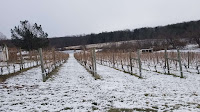
In 1910, just before the automobile swept aside the Old Dominion Railroad, a dairy barn was built that a century later would house the tasting room for The Barns at Hamilton Station Vineyards.  This winery was founded by the Fialdini family and two of their most enlightened decisions were to restore the dairy barn and to hire acclaimed Michael Shaps as the winemaker.  Their wines are made from grapes grown on their small estate as well as other mature Virginia vineyards such as Carter's Mountain and Mount Juliet Vineyards. Here's the review of my visit posted on Instagram

I'm embarrassed to confess that yesterday was my first visit to The Barns at Hamilton Station Vineyards. The wines were what you would expect from Michael Shaps with the 2019 Cascina ($26) -- Seyval Blanc, Traminette, & Petit Manseng -- the table's favorite. I was also impressed with their 2018 Cabernet Franc ($24) and Petit Verdot ($28) for not only salvaging the rain-soaked grapes but producing very drinkable wines with them. The 1910 era barn is very cozy during the winter months and Ryan Jewel Music has a great country voice beyond his years. We look forward to returning in the spring to lounge on their patio and enjoy more wine and the surrounding views.

Saturday, January 22, 2022

CiderCon 2022 – Interview with Keynote Speaker Diane Flynt

CiderCon 2022
, the annual trade conference of the American Cider Association will be held in Richmond, Virginia from February 1-4, with excursions scheduled for two days prior. I published a preview and interview with Keynote Speaker Diane Flynt at BevFluence, but thought our readers would be interested in some of her comments on the industry since closing Foggy Ridge Cider (click the link above for the entire interview).  And privately we reminisced about our long-ago video with The Reverend Peyton's Big Damn Band.  

During the conference, I plan on attending these sessions: Top of the Mitten: High Latitude Ciders from Northern MichiganA Cider Among the Faults; and 400 Years of American Alcohol: Cider, History, Cocktails and More. I will also spend most of the after-hours at Bryant's Cider.  Let me know on social media if you plan on attending and we will share a pint of cider. Cheers. 

What have you been doing since the last release of Foggy Ridge ciders? 
Since releasing Foggy Ridge Cider’s Final Call blend in 2018, we have sold our apples to cidermakers in Virginia, North Carolina, and Tennessee. In early 2020 I signed a contract with the University of North Carolina Press to write a general trade book on the history of apples in the South. This book focuses on the stories and history behind the South’s almost 2,000 apple varieties. Through research at University Special Collections, the National Agricultural Library, and interviews with multi-generation apple growers I’ve learned surprising stories about southern apples. The book should be published in 2023. 

What can content creators do better or more in helping to promote the cider industry?
Many in the cider world are proud to say we are a “big tent” industry, and that there is a place for every price point, every method of production, and every quality level for ingredients…from apple juice concentrate to estate-grown cider apples. While this view has merits, it also flattens the discussion. I’d like to see content creators dig deeper into the ingredients and production methods of top-quality cider. Content creators are smart people, “thinking drinkers” if you will, and you should be able to see what is a “marketing message” from producers and what is an authentic practice or value that is carried out in cider-making every day. I see too much content that seems generated by a PR engine for a cider company large enough to hire a PR engine. 


Monday, January 17, 2022

Nelson County Route 151: Bryant’s Cidery & Brewery

This Saturday I had an engaging visit to Bryant’s Cidery & Brewery where founder Jerry Thornton was managing the taproom. Over a couple of flights of cider and beer, he provided an overview of his operation and the significant history of the Century Farm property.  In 1865, Maj Waller Massie Boyd returned from the Civil War and was given a tract of land by his father that included an overseer’s log cabin.  Boyd established an orchard called Edgewood which has remained in the same family through six generations for these 155+ years establishing the Century Farm designation. Thornton recalled the reasoning behind the name, "by the early 1900s a granddaughter of Boyd married R.L Bryant whose family farmed nearby. R.L expanded the orchards and built the infrastructure to support the farm".  Historic photos document the family and property's response through aviation in both world wars and to national calamities. 

In establishing the cider house, Thornton refurbished a barn for the tasting room and the overseer’s log cabin for the production facility. The taproom has a very rustic feel with the walls populated with historic photos documenting the family and property's response through aviation in both world wars and to national calamities. He also kept the feeding trough and reclaimed beams and boards & planks from the 1700s.

Bryant's offers a diverse selection of ciders with many infused with fruit or aged in barrel. For the tart sour beer fam in me, I enjoyed the Unicorn Fuel, a brut cider infused with organic rosehips and hibiscus. The Legend (I believe that was the name) was another favorite - a cider infused with coffee and cocoa bits. For the beer, the Roberta's Revenge Stout is solid - far from an Irish stout and more an American stout with chewy malts and dark chocolate on the tail.

However, the cider that immediately captured my attention and proved that Thornton was a serious producer was the brut Brite Good.  This cider is bone dry but packs plenty of tart apple flavor, finishing with refreshing effervescence. I mentioned the possibility of blending with Campari and confirmed the next day that this combination works beautifully.

I'm looking forward to visiting their Richmond taphouse during CiderCon early next month. But for those who are touring Nelson County's Route 151 or staying at Wintergreen, just keep driving south -- over the mountain pass -- to Bryant and the cider house. It's well worth the extra 20 minutes.