
Thursday, September 20, 2012
Kiwi Day Dreaming, #winechat, & New Zealand Sauvignon Blanc


Tuesday, September 18, 2012
The United Grapes of America - Tennessee - Countryside Vineyards Chambourcin

 I leveraged a trip to the Bristol Rhythm & Roots Reunion to visit Countryside Vineyards & Winery, located not far down Route 81 in Blountville, Tennessee. There are about three dozen wineries operating in the Volunteer State (visit Tennesse Wine Country), with most producing wine from French hybrids, native labrusca grapes, or country wines from berries. Countryside opened just over a decade ago and owner-winemaker Jim Thomas is most proud of his Chambourcin. This French-American hybrid was developed by Joannes Seibel in the Loire Valley of France in the 1860s - probably to help alleviate the affects of the phyloxera epidemic. However, it wasn't until the 1970s that the grape was planted widely in the United States for commercial use. Since then, its planting
 has exploded because of its vineyard hardiness (cold and humidity) and diversity in styles. It can be vinified into a full or medium bodied dry red, a rose, or even a sweeter wine. Countryside's Chambourcin is a medium bodied wine, with smooth cherry-chocolate flavors, and a slightly peppery finish. The is a nice, easy drinking wine; affordable ($13); and worthy of the winery's praise.
 |
| StarChefs.com: The United Grapes of America |
Tuesday, September 11, 2012
The United Grapes of America - Washington - Chateau Ste. Michelle Rieslings
|
| StarChefs.com: The United Grapes of America |
 We continue our Pacific Northwest and the Summer of Riesling binge with Washington State's oldest winery, Chateau Ste. Michelle. The winery was founded in 1934 - that's getting an early post-Prohibition start - and is located northeast of Seattle, in Woodinville. Although the estate vineyards are located in the Puget Sound AVA; many of their wines are made from grapes harvested in the Columbia Valley AVA. This is the largest AVA in the Evergreen State, accounting for "99% of wine grapes. (See the Washington Wine Commission for more facts on Washington wines.) Riesling is a major player in the area and benefits from the warm, sunny days and cool evening temperatures. And Chateau Ste. Michelle produces three versions of Riesling which the recently sent me: a 2011 Columbia Valley Dry Riesling, a 2011 Columbia Valley Riesling, and a 2011 Columbia Valley Harvest Select Sweet Riesling.
 I tasted these wines on multiple occasions over the weekend, and all are very nice; and every time I preferred the 2011 Harvest Select Sweet Riesling. This wine possesses a strong peach profile - both in the aroma and flavor - but the wine's acidity has no problems balancing the 5.2% R.S. At times this wine reminded me of several local Petit Mangseng wines I've tasted recently - refreshing even with the sugar. The Columbia Valley Riesling is made semi-dry at 2.2% R.S. and like the previous, the acidity had no problems balancing the sugar. In fact, I didn't even notice the sugar, just this time an apricot profile with the lemon-tart finish. And this wine tamed a couple spicy fish tacos. The Columbia Valley Dry Riesling is very clean, with more citrus flavors accompanied by the now familiar crisp acidic finish. Yet, this wine just didn't have the full flavor profile as the others. Not bad, but for my tastes, I seem to prefer a little more R.S. in my Riesling. All in all, a nice set of wine; cheers to Columbia Valley Riesling.
Tuesday, September 4, 2012
The United Grapes of America - Idaho - Sawtooth Winery Riesling

 It's still the Summer of Riesling so we turn to Idaho where Sommelier Vino50.com recommended Sawtooth Winery and we selected their 2011 Riesling (a blend of 95% Riesling and just 5% Muscat Blanc). Any discussion of Northwest wine production should not be monopolized by Oregon and Washington; Idaho and British Columbia should be included - particularly since the first vines in the Pacific Northwest were planted in Idaho in the 1860s. The terrior in Idaho is similar to that of eastern Washington & Oregon except its higher elevation produces a larger diurnal temperature variation. We are talking 30*-40* at the highest elevations. The Snake River Valley was Idaho's first
designated American Viticultural Area (AVA) and encompasses the strategic 43°- 46° latitudes. Sawtooth Winery was founded in 1987 as started as Pintler Cellars, with early plantings of Chenin Blanc, Riesling, Semillon, Chardonnay, Cabernet Sauvignon. In 1998 Pintler joined Corus Estates & Vineyards and was re-branded as Sawtooth Winery - honoring the Sawtooth Mountains. Today Sawtooth is one of about forty wineries operating in the Gem State.
It's still the Summer of Riesling so we turn to Idaho where Sommelier Vino50.com recommended Sawtooth Winery and we selected their 2011 Riesling (a blend of 95% Riesling and just 5% Muscat Blanc). Any discussion of Northwest wine production should not be monopolized by Oregon and Washington; Idaho and British Columbia should be included - particularly since the first vines in the Pacific Northwest were planted in Idaho in the 1860s. The terrior in Idaho is similar to that of eastern Washington & Oregon except its higher elevation produces a larger diurnal temperature variation. We are talking 30*-40* at the highest elevations. The Snake River Valley was Idaho's first
designated American Viticultural Area (AVA) and encompasses the strategic 43°- 46° latitudes. Sawtooth Winery was founded in 1987 as started as Pintler Cellars, with early plantings of Chenin Blanc, Riesling, Semillon, Chardonnay, Cabernet Sauvignon. In 1998 Pintler joined Corus Estates & Vineyards and was re-branded as Sawtooth Winery - honoring the Sawtooth Mountains. Today Sawtooth is one of about forty wineries operating in the Gem State.Andrew Stover of
|
| StarChefs.com: The United Grapes of America |
Tuesday, August 28, 2012
The United Grapes of America - New Mexico - Gruet Winery Blanc de Noirs

 Gruet Winery is probably the most popular winery - assisted by its wide distribution network - selling over 100,000 cases to 48 states. The winery was founded by French champagne producer Gilbert Gruet after he and his family visited the American southwest in 1983. As a result of meeting a group of New Mexican winemakers, they (Gruet; his
children, winemaker Laurent and daughter Nathalie; and family friend
Farid Himeur) planted an experimental vineyard with Pinot Noir and Chardonnay grapes near the town of Engle. The vineyards are situated at 4,300 feet, allowing for large diurnal temperature change between the extremely hot days and cool nights. Plus, there's little humidity to contribute to grape rot. An excellent location. And using the traditional grapes from Champagne, New Mexican sparkling wine was born.
Gruet Winery is probably the most popular winery - assisted by its wide distribution network - selling over 100,000 cases to 48 states. The winery was founded by French champagne producer Gilbert Gruet after he and his family visited the American southwest in 1983. As a result of meeting a group of New Mexican winemakers, they (Gruet; his
children, winemaker Laurent and daughter Nathalie; and family friend
Farid Himeur) planted an experimental vineyard with Pinot Noir and Chardonnay grapes near the town of Engle. The vineyards are situated at 4,300 feet, allowing for large diurnal temperature change between the extremely hot days and cool nights. Plus, there's little humidity to contribute to grape rot. An excellent location. And using the traditional grapes from Champagne, New Mexican sparkling wine was born. |
| StarChefs.com: The United Grapes of America |
Friday, August 24, 2012
Ron Zacapa 23 - From Cane to Solera to Bottle

Before tasting, let's start with their distilling process. As previously mentioned, the rum starts from sugar cane and not molasses. Zacapa's sugar cane is harvested from their plantation "located on the volcanic plains of Retalhuleu, 1,148ft above sea level in south-western Guatemala". The sugar cane is then pressed, and the first press is then fermented using their own strain of yeast extracted from pineapples. The fermented juice is then distilled using a single column copper still.
 |
| Tasting vials from stages in the Solera process |
The Zacapa Solera process uses four criadera and the tasting kit includes samples from three of these, as well as the finished solera. (See the image below for more detail.) The attached video also describes the contents of the tasting kit, and whereas my tasting was less formal, I gained a greater appreciation how each step in the Solera process contributes to the overall complexity of Ron Zacapa 23. In Stage 1, the distilled sugar cane is aged in used American white oak Bourbon barrels for one to three years. The rum is then moved to the 4,500 gallon American Oak intermediate vat where it is blended with older lots. This mixture is then aged in charred Bourbon barrels, resulting in more oak flavors imparted into the spirit. This rum sample is reminiscent of a solid, slightly aged rum, with sugar cane aromas, sweet honey flavors and a slight burn at the tail. I could drink this version, at any time, with no second thoughts.
 |
| The Zacapa Solera Process |
The sherry infused rum is added back to the vat, augmented by the reserve, and then sent to the fourth criadera or Stage 3 and aged in used Pedro Ximenez (PX) wine barrels. PX is a white Spanish grape used in sherry and sweet dessert wines. This sample was much more palatable than the last, exuding a similar nutty aroma but with a fig and banana-ish flavor and milder, albeit, still strong finish. Close, but not quite the same as the finished solera. It was also very 2-dimensional, running straight from the mouth to the tail, without much of the creamy mid-palette I associate with Zacapa 23.
This blend is then added back to the gigantic intermediate vat and then blended into the older lots in the reserve. Some of the rum is used to augment future processes whereas some are filtered and bottled into the distinctive Ron Zacapa 23 bottles. This last sample - Stage 4 - was the final product that I've come to love about this rum - the honey and nutty aromas mingle with the sweet honey, fig, and raisin flavors; followed by a satiating and creamy mid-palette; and ending with a long fresh finish - with zero - I mean zero - burn. Love it. The distillers at Ron Zacapa have patented this process into a science or art, because I was unable to capture this profile using my own blends of the three vials.So there you have it - Ron Zacapa 23 - From Cane to Solera to Bottle. Cheers
Tuesday, August 21, 2012
The United Grapes of America - Missouri - Stone Hill Winery Norton Port

 Missouri=Norton. That's basically what you need to know about the ® (thanks Chrysalis Vineyards) to a new level of quality and consumer acceptance. In order to learn more about the native Virginia grape, we recommend Todd Kliman 's The Wild Vine: A Forgotten Grape and the Untold Story of American Wine. And it was Kliman who recommended the Norton wines from Stone Hill Winery in the The United Grapes of America. And why not. The winery is listed in Paul Lukacs book, The Great Wines of America: The Top Forty Vintners, Vineyards, and Vintages because of their ability to produce quality Norton wines each and every year. Before prohibition, it was the second largest winery in the United States and was "winning gold medals in eight world's fairs,
including Vienna in 1873 and Philadelphia in 1876". All that fell apart after prohibition until Jim and Betty Held purchased the property in the mid 1960s. They restored the winery, now listed on the National Register of Historic Places, and resumed producing quality wine recognized by Lukacs and seven Missouri Governor's Cups since 1994. As detailed in Kliman's book, cuttings from Stone Hill were used by Dennis Horton at Horton Vineyards to revive the Norton grape in its native Virginia.
Missouri=Norton. That's basically what you need to know about the ® (thanks Chrysalis Vineyards) to a new level of quality and consumer acceptance. In order to learn more about the native Virginia grape, we recommend Todd Kliman 's The Wild Vine: A Forgotten Grape and the Untold Story of American Wine. And it was Kliman who recommended the Norton wines from Stone Hill Winery in the The United Grapes of America. And why not. The winery is listed in Paul Lukacs book, The Great Wines of America: The Top Forty Vintners, Vineyards, and Vintages because of their ability to produce quality Norton wines each and every year. Before prohibition, it was the second largest winery in the United States and was "winning gold medals in eight world's fairs,
including Vienna in 1873 and Philadelphia in 1876". All that fell apart after prohibition until Jim and Betty Held purchased the property in the mid 1960s. They restored the winery, now listed on the National Register of Historic Places, and resumed producing quality wine recognized by Lukacs and seven Missouri Governor's Cups since 1994. As detailed in Kliman's book, cuttings from Stone Hill were used by Dennis Horton at Horton Vineyards to revive the Norton grape in its native Virginia.Missouri wine industry. Yes, there's Vignole, Chardonel, Chambourcin, & St. Vincent; but Missouri wineries have raised the Real American Grape!
|
| StarChefs.com: The United Grapes of America |
We learned in at the National Norton Festival that Norton wines should mature in the bottle for at least three years after bottling. Most Missouri wineries join Stone Hill in cellaring the wine for you for a couple years before releasing. The same holds for their Port. Along with their vinification methods, the wine does not possess any of the highly acidic and grapey characteristics of young Norton. The flavor is rich with a blackberry profile and a hint of nuttiness & spiciness that is usually associated with Old Aged Tawny Port. Yes this wine isn't Portugal - but it is a very good American and Missourian port styled wine.
Talking Norton and DLW with Jennifer McCloud
Friday, August 17, 2012
Cider 101 - Spencerville Red and Black Twig

Another single varietal apple cider from Great Shoals is their Black Twig Hard Apple - officially recognized as Delaware’s first hard cider. That is, the apples were harvested from TS Smith and Sons - not far north of the winery in Bridgeville, Delaware. Legend has it that the Black Twig apple variety was first grown near Fayetteville, Tennessee during the 1830s - very Jacksonian of it. The apple is both sweet and tart - some refer to it as extremely tart, with a tannic finish. Like the Spencerville Red, the Black Twig Hard Apple is bottle conditioned sparkling and also labelled a wine because of its alcohol content. However, its flavor profile is completely different - with fuller flavors and the tannins are evident on the tail. Again, at $15, this is a nice value. And now we have to new apple varieties to add to our lexicon, Spencerville Red and Black Twig.
Tuesday, August 14, 2012
The United Grapes of America - Oregon - A to Z Wineworks Pinot Noir

|
| StarChefs.com: The United Grapes of America |
 Pinot Noir. That's what fellow bloggers will be consuming this week in Portland Oregon for the 2012 Wine Bloggers Conference. Yes, there will be other wines, Pinot Gris, Pinot Blanc, Riesling, Chardonnay, and your standard Bordeaux fare; but in the Beaver State - Pinot Noir is King - or Queen. There is even an Oregon Pinot Noir Club. The first post-prohibition The United Grapes of America I decided to feature one that is priced below $20 and readily available: the A to Z Wineworks 2010 Pinot Noir. The wine was produced from grapes harvested from 30 different vineyards and 60 different fermentation. Plus, 62% of these vineyards are certified sustainable - a very important attribute for environmentally conscious Oregon. The wine itself is medium bodied with red cherries and raspberry flavors, velvety mid-palatte, and a slightly acidic and spicy finish. All in all - a nice, easy drinking wine with plenty of value.
 Pinot Noir was planted in the Willamette Valley and by the 1980s. Today there are over 400 wineries in Oregon - probably closer to 500 - so there are plenty of Pinot Noir to sample. For
Wednesday, August 8, 2012
The United Grapes of America - New York - Warwick Valley Winery's Black Dirt Red
 |
| Black Dirt Red Overlooking Greenwood Lake |
|
| StarChefs.com: The United Grapes of America |
 The wine is composed of 100% Baco Noir, a French-American hybrid grape produced by crossing Folle Blanche, a French wine grape, and an unknown variety of Vitis riparia indigenous to North America. The grape is cold tolerant so does well in the Northeast and Canada - and particularly the Hudson Valley. The wine's name refers to the agriculture area centered in Warwick, New York - the Black Dirt Region. This area is comprised of very fertile black soil, "left over from an ancient glacial lake bottom augmented by decades of past flooding of the Wallkill River".
  |
| Doc's Draft Ciders |
Note: the Doc's Draft Ciders are also highly recommended. I tried the Apple, Pear and Sour Cherry - all have great fruit - which produces a fuller flavor profile than most dry ciders.
Friday, August 3, 2012
Visiting Fauquier County Wineries with Northern Virginia FLITE Tour
 Last week we participated in the Fauquier County day of the two day Virginia First Lady Maureen McDonnell FLITE (First Lady's Initiatives Team Effort) tour of northern Virginia wineries. The purpose of FLITE is to "bring attention to the great work being done by selfless people around the Commonwealth who are taking the opportunity to leave Virginia a better place than they found it". In addition, the First Lady uses these tours as a Bully Pulpit to encourage retailers and restaurants to include local Virginia wine in their portfolio. Thus, our tour was primarily composed of members of those markets as well as a few members of the media, a blogger or two, as well as First Lady Maureen McDonnell and Secretary of Agriculture & Forestry Todd Haymore.
  |
| Left Bank Vineyard at Delaplane Cellars |
 |
| Tasting at the Wine Bar |
We then headed just down the road to Paris, Virginia and lunch at the Ashby Inn And Restaurant. Here our sweet and sour radish soup and crispy port belly were paired with the Pearmund Cellars 2011 "Vinecroft" Viognier and the Chester Gap Cellars 2009 Cabernet Franc respectively. This magnificent lunch definitely gave the sommeliers in our group inspiration to pair local wine with local produce.
 |
| Jim Law |
 |
| Hardscrapple Vineyard at Linden Vineyards |
And this tour was another example of the McDonnell Administration promoting these excellent wines to local establishments. Several Linden, Chester Gap, and Pearmund wines are available in my area - hopefully they will be available in yours very soon.
Wednesday, August 1, 2012
The United Grapes of America - McPherson Cellars Texas Tre Colore

|
| StarChefs.com: The United Grapes of America |
 Depending on who you talk to, Texas is either the 5th or 6th largest wine producer in the The United Grapes of America and the Lone Star State seems to have found a home for Italian and Rhone grape varieties. McPherson Cellars from Lubbock is featured in the StarChefs.com article and I picked up their 2010 Texas Tre Colore specifically because of the southern Rhone blend of Carignan (27%), Mourvedre (62%) and Viognier (11%). I mean, what a great combination of grapes and this is one excellent medium bodied, easy drinking wine. There are very little tannins in this wine, thus its perfect for consuming solo and the red cherry flavor fits our palette perfectly. Even our Pinot Noir centric friends enjoyed this one. Winemaker Kim McPherson and his father "Doc" were instrumental in jump starting the early Texas wine industry and you can read about that history at the winery's website. Cheers to a fine Texas wine.
 Notes: The Tre Colore was purchased at Wholefoods for $15.
Monday, July 30, 2012
Pairing Virginia Wine and Cigars at Floydfest


Wednesday, July 25, 2012
The United Grapes of America - Florida's Keel And Curley Winery Blueberry Wine

|
| StarChefs.com: The United Grapes of America |
 You know you may have a problem when on the day your son is flying home from Florida you frantically call his host to include two bottles of your favorite Florida wine, the Keel And Curley Winery Dry Blueberry. Now the original The United Grapes of America StarChefs.com article mentions wines from Schnebly Redland's Winery, but these tropical fruit based wines are generally too sweet for my tastes. On the other hand, the K&C blueberry is completely dry with a big nose and can be mistaken for a medium-full bodied malbec if one was tasting blind. The wine is made from High-Bush
Blueberries grown in their
Plant City farm about 20 miles east of Tampa Bay. The blueberries are fermented on the skins which helps retain the key benefits of this super fruit: vitamin C and antioxidants. In fact a new University of Florida study fund that "wine made from southern highbush berries had more antioxidants than
white wine and all but 20 percent of the reported values for red wines..." That could be why in 2011, 300,000 bottles of blueberry wine were sold throughout the Sunshine state. Glad I scored my two bottles. Cheers.
You know you may have a problem when on the day your son is flying home from Florida you frantically call his host to include two bottles of your favorite Florida wine, the Keel And Curley Winery Dry Blueberry. Now the original The United Grapes of America StarChefs.com article mentions wines from Schnebly Redland's Winery, but these tropical fruit based wines are generally too sweet for my tastes. On the other hand, the K&C blueberry is completely dry with a big nose and can be mistaken for a medium-full bodied malbec if one was tasting blind. The wine is made from High-Bush
Blueberries grown in their
Plant City farm about 20 miles east of Tampa Bay. The blueberries are fermented on the skins which helps retain the key benefits of this super fruit: vitamin C and antioxidants. In fact a new University of Florida study fund that "wine made from southern highbush berries had more antioxidants than
white wine and all but 20 percent of the reported values for red wines..." That could be why in 2011, 300,000 bottles of blueberry wine were sold throughout the Sunshine state. Glad I scored my two bottles. Cheers.
Saturday, July 21, 2012
Civil War & Wine at The Winery at Bull Run

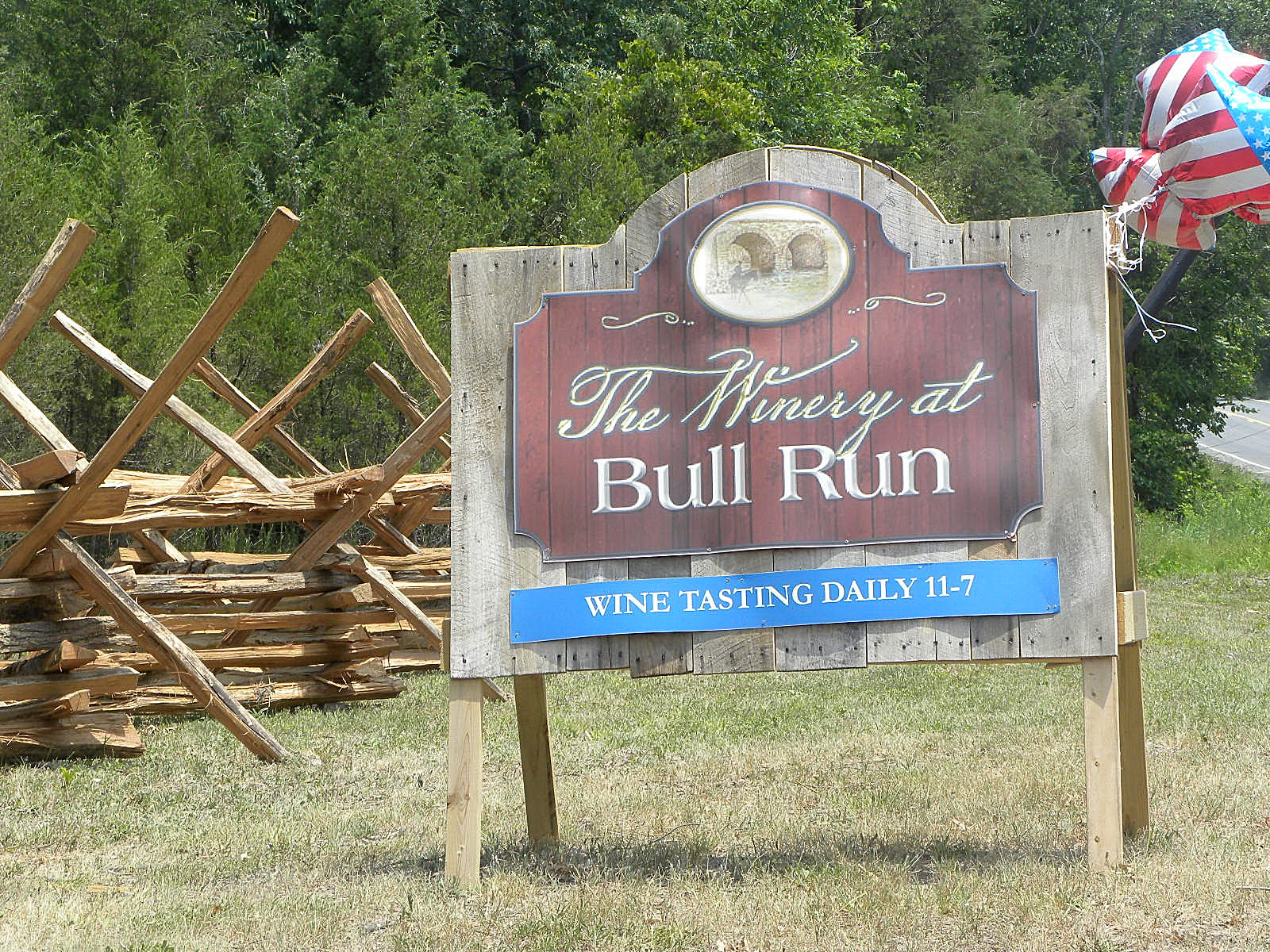
Last week I visited northern Virginia's newest winery, The Winery at Bull Run, located adjacent to the Manassas National Battlefield Park. And this proximity to the park is what would draw history buffs as well as wine lovers to Centreville. The winery is located on the former Hillwood estate with ruins of the former mansion used as a patio. Parts of the First Battle of Bull Run (First Manassas) were near the Hillwood estate - most notably at the Stone Bridge - also adjacent to the winery and the southern part of the Park. With that in mind, proprietor Jon Hickox exhibits Civil War relics within the winery - some collected from the property and others donated by collectors. He also placed markers throughout the property describing the mansion and what the battlefield looked like from that location. The museum and markers are reason enough to visit this infant winery.

 "Delaney" - a blend of 40% Traminette, 30% Vidal Blanc, 20% Viognier, & 10% Riesling. Plus the "Fort", a Chambourcin port-styled dessert wine. For my tastes, the wines were okay. The chardonnay was typical Pearmund - more on the oaky side; the Viognier, oddly off-dry. The Delaney blend was spot on for those grapes as was the Norton, not over-acidic and jammy. These wines are pricey - you pay for the Pearmund winemakers and location: high 20s to $32 for the reds; $24-$27 for the whites; and $38 for the Fort. For me too expensive for everyday consumption but worth a bottle when soaking up the Civil War history.
Wednesday, July 18, 2012
The United Grapes of America - Michigan's Chateau Grand Traverse Ship of Fools
 | |
| Ship of Fools with the Ocracoke Lighthouse |
|
| StarChefs.com: The United Grapes of America |
 Chateau Grand Traverse has been operating for over three decades - specializing in Riesling, but for this post we feature their Ship of Fools ($15) Pinot blend of Pinot Blanc, Pinot Gris, and Pinot Noir. That may be a one of a kind catch. Obviously the 45° latitude caters to Pinot and the 55% Pinot Blanc provides a suitable bearing to savor this wine, with the Pinot Blanc the sails and the Pinot Noir the nautical rustic charm. Seriously, this is a nice wine - balanced between the subtle grapefruit flavor and mild acidity - with good texture in between. I would also recommend pairing any Pinot Blanc based wine with food. And take a voyage through the Great Lakes to Lake Traverse Michigan. Cheers.
Monday, July 16, 2012
Beer and Wurst on the Outer Banks

A few years ago I read an article called 50 beers to drink before you die and recognized a brewery I'd seen while driving to the Outer Banks, the Weeping Radish Farm Brewery. Their Black Radish (Schwarzbier) was listed and I had tried this dark German styled lager before and had always enjoyed that beer as well as that style. Last week I had a chance to visit the brewery while heading down to OBX. The facility is located in Jarvisburg NC, eleven miles north of the Wright Memorial Bridge leading into Kitty Hawk.
 Weeping Radish brews primarily German styled lagers and keeping with the Purity Law of 1516 (Reinheitsgebot), they utilize just water, hops, malt and yeast in the brewing process.They offer a range of styles from though out Germany, from Munich and Cologne (Kölsch) to Marzen and Weizen. During our visit we sampled their entire portfolio (seven beers) and all were spot on for their style. The OBX Kolsch was light and refreshing, the Corolla Gold (Munich Helles) was a little sweeter, and the Fest and Black Radish were right on. I definitely think a Schwarzbier is a style everyone should sample before they die - so why not the Black Radish - basically a milder form of Porter. The most interesting brew was the Radler - based on the Biermischgetränk (beer mixed with Lemonade or cola) - with this version mixed with Lemonade. The citrus flavor was mild and really was only apparent at the finish. It received mixed reviews with our crowd one pro and one preferring others.
As the name applies, the Weeping Radish Farm Brewery is also a working farm. Goats range in front of the brewery and they provide a range of sausages and liverwurst. My favorite was the sweet potato wurst - with onions and bread - and paired with the Weizen - some sweet and sour flavors. All in all, this is a great place to stop on the drive down. The main complaint, the vessels sold to hold the beers are not very compatible for beach or pool drinking - 22oz bottles. Where are the cans? :) Cheers.
Subscribe to:
Posts (Atom)